Auckland
Future – 2026
By Malcolm Taylor Space, Silence and Structure What Stewart Copeland (Opera Composer, Movie Soundtrack creator and Drummer of The Police) taught me about tension, rhythm and design.During his recent speaking tour, I had the opportunity to ask Stewart Copeland a... Read more
By Malcolm Taylor
Space, Silence and Structure
What Stewart Copeland (Opera Composer, Movie Soundtrack creator and Drummer of The Police) taught me about tension, rhythm and design.
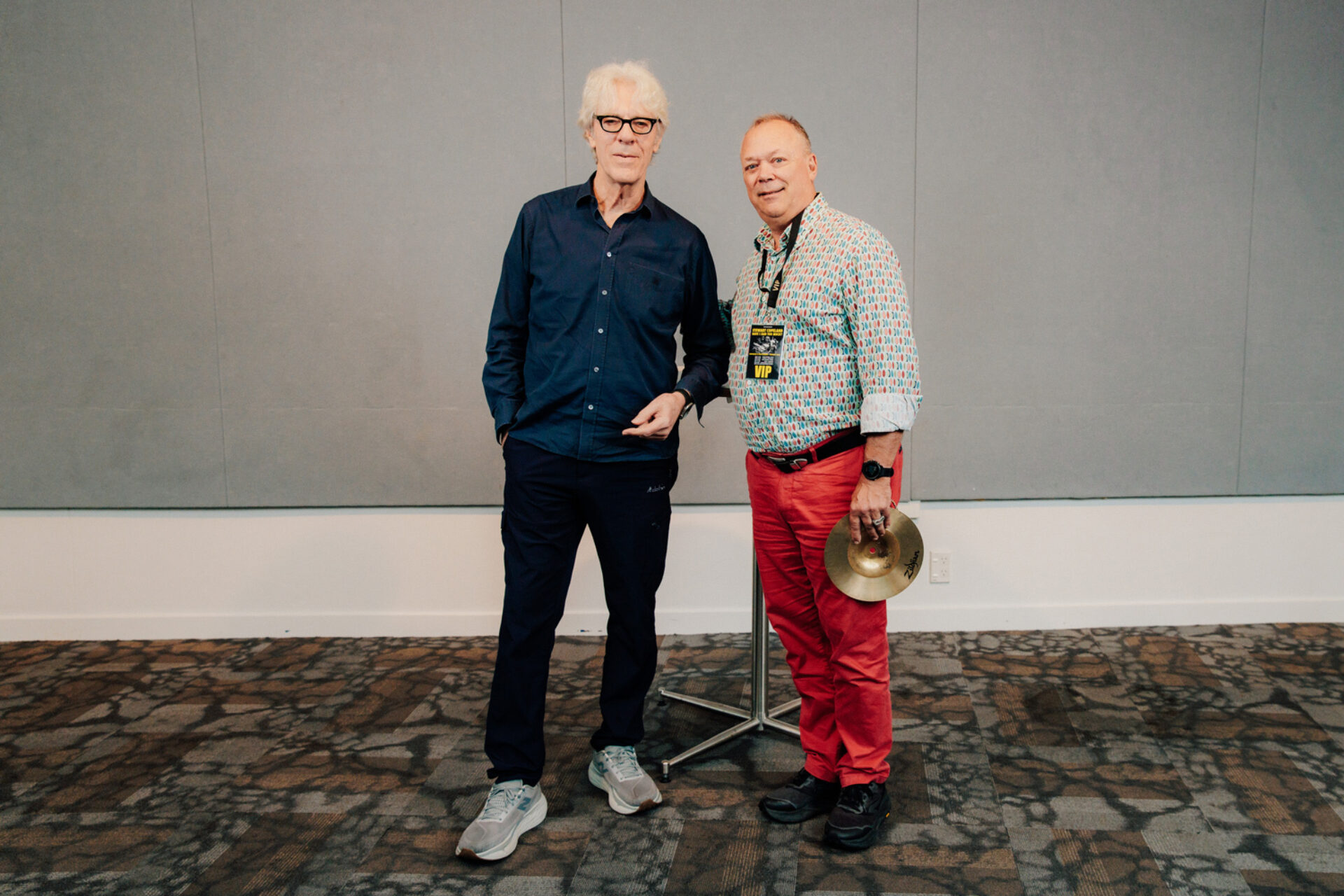
During his recent speaking tour, I had the opportunity to ask Stewart Copeland a question that has long sat at the intersection of my own practice and interest regarding music and architectural space (…yoga breath is for another day):
Many of your drum parts use space and silence almost as instruments. Was that something you pursued consciously, or did it emerge from your listening philosophy?
Copeland’s response revealed the influence of his upbringing through to his ongoing contemporary practice in opera composition.
Using Silence as an Active Material
He began by referencing reggae rhythms (previously he had noted the influence of Middle Eastern music), where the absence of sound on the fourth beat of the bar creates tension before the next phrase. That pause, the held moment, becomes an accent. Silence, in this sense, is not passive. It is a mechanism.
Copeland described this silence as a simple but powerful device: leaving space at the end of a phrase to create emphasis. The music resolves not through addition, but through withholding. The tension lives in what is not played.
This idea extends beyond rhythm into orchestration and composition, where the collection point (often the end of a phrase), becomes the moment that defines the whole.
This understanding of space as an active material resonates strongly with my own design practice. At Malcolm Taylor Architecture you have may have heard me talk about Tension and Release, and in the Design area our lightshades explore rhythm through shadow and repetition, using pattern and pause to shape how light is experienced within a space.
Much like Copeland’s approach to music, the effect is not created through excess, but through restraint: allowing absence to heighten presence.
White Space, Negative Space and Anticipation
As the conversation unfolded, the language became strikingly consistent with architectural and visual design concepts. Copeland spoke about white space and negative space, visual terms that translate seamlessly into sound.
The space after an accent, the silence following a phrase, is what sets up an. ti. ci. pation.
It is where tension accumulates, waiting for resolution. In architectural terms, it is the pause between rooms, the threshold, the void that gives form its meaning.
Tension as a Creative Catalyst
This idea of tension carried through Copeland’s reflections on his career, particularly his time with The Police. He described being in the band, memorably as “wearing a designer suit made of barbed wire.”
The collaboration between himself and “Stingo” was not incidental; it was foundational, and also painfully frictional. Their musical intentions were different, and rather than smoothing that over, the band’s sound thrived on it. It was their secret sauce. It also culminated in extensive band therapy sessions mid-tour.
Traditionally, rhythm sections lock together with bass and drums reinforcing one another. Copeland deliberately did the opposite. He played in the spaces Sting didn’t, creating a constant, angsty dialogue. The result was music built on tension and release (that term again…), not unlike architecture that gains its power from contrast rather than harmony.
Intuition, Jazz and The Moment
Copeland’s drumming practice was deeply instinctive. Influenced early by jazz drummers like Buddy Rich, he approached recording as a one-off event, playing entirely in the moment.
Then came the hard part. After recording, he would spend months relearning parts that had emerged intuitively, a process he described as exhausting rather than creative. Jazz, after all, is not meant to be repeated. It exists once, fully, and then disappears.
That tension between instinct and structure mirrors familiar architectural and design challenges: the shift from concept to documentation, from improvisation to precision.
Anarchy to Authorship
Copeland reflected that his contemporary work within the operatic genre, is at the opposite end of the intuitive spectrum. Today, he says, everything is written down. Everything is structured. But crucially, he now holds full creative control.
That shift from collaborative tension to individual authorship, has allowed him to find what he described as his happy place. The discipline remains, but that intense conflict of two diverging creatives has gone.
Bringing it to your own Creative Practice
For architects, designers musos and other creative humans, Copeland offers a reminder and an opportunity to reflect on your process:
- Space is not emptiness, it is active
- Tension is not a flaw, it is productive
- Intuition and structure are not opposites, they are phases
- The most memorable work often comes from resisting resolution
- If you’re in a band, it’s important to earn enough to hire a psychologist.
Whether in music or architecture or another creative pursuit, meaning often emerges not from what we add, but from what we deliberately leave out.
Silence, like space, is a material.
Thoughts following Stewart Copeland’s “Have I Said Too Much?” tour talk, Auckland, New Zealand, 21 January 2026.
Image Credit: Ralph_PH via Creative Commons Licence (no changes made)
This article in no way that suggests Stewart Copeland, and the licensor of the main photo endorse this organisation or content.